Welcome to the World of PCR and qPCR
Solid knowledge, proven tips, and clever solutions for everyday lab work. qPCR Lumie supports you and answers all your questions about PCR and qPCR, from the basics to targeted troubleshooting.
From 1 October to 18 December 2026, order any qualifying PCR or qPCR product and claim a free qPCR Lumie for your desk or lab bench, just complete this form*

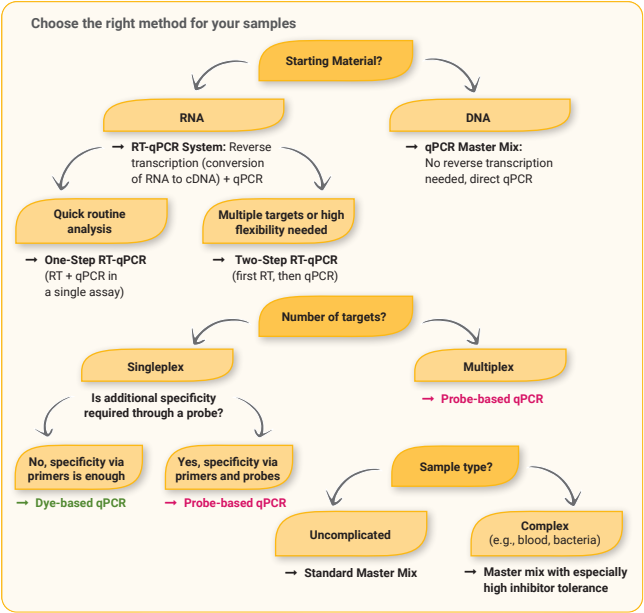
Choosing the Right Master Mix Makes All the Difference!
qPCR results don't always meet expectations, especially with challenging sample matrices. That's where we can help:
Shifted Cq values? Inhibitors could be the cause!
Small shift, big impact: A Cq decrease of 3.3 cycles ≙ 10× starting quantity
- Inhibitors reduce polymerase activity.
- Result: distorted data and reduced efficiency.
How do inhibitors get into your sample?
- Ethanol: residues from nucleic acid purification
- EDTA, heparin and sodium citrate: anticoagulants
- Humic acids: soil and environmental samples.
Our solution: GoTaq® Endure qPCR Master Mix
- Maximum tolerance against PCR inhibitors
- Reliable results even with complex matrices
- Probe-based for highest specificity.
Protect your experiments from inhibitors and achieve reproducible results every time.
Webinars
From Signal to Insight: Making Sense of Your qPCR Data
Basics, Validation and Troubleshooting
Thursday, 1 October 2026
10am (BST)
Ellie Kirby | Product Manager, Promega UK
Mark Coldwell | Technical Support Scientist, Promega UK
Real-time PCR underpins modern molecular diagnostics, quality control, and gene expression analysis, yet many practitioners struggle to extract reliable quantitation from raw data. This foundational webinar covers the principles of qPCR signal detection, including dye-based and probe-based chemistries, and demonstrates how to interpret amplification curves and Cq values with confidence. We address critical assay validation metrics (efficiency, linearity, specificity, repeatability, sensitivity) and provide systematic troubleshooting strategies for common qPCR challenges, ensuring that qPCR success depends on proper sample quality, correct assay design, and understanding the relationship between signal and template concentration in the exponential phase.
In this webinar, you will learn how to:
- Master qPCR chemistries and signal detection - understand SYBR Green vs. TaqMan approaches, how fluorescent signals correlate to product formation, and the importance of melting curve analysis for specificity confirmation
- Extract and analyse Cq values correctly - convert quantification cycles to absolute or relative quantity using standard curve methods with proper efficiency corrections
- Validate assays and troubleshoot systematically - apply critical validation parameters including primer/probe design, standard curve requirements (5 log dilutions, >90% efficiency, R2>0.98), and diagnose common issues such as PCR inhibition and poor efficiency.
Optimization of qPCR Workflows: From Sample to Multiplex Assay
Basics, Validation and Troubleshooting
Tuesday 3 November 2026
10am (GMT)
This advanced webinar focuses on optimizing the complete qPCR workflow from sample collection through multiplexing, with emphasis on quality control at every step. It covers critical upstream processes including nucleic acid extraction, purity and integrity assessment, reverse transcription strategies, and advanced applications like high-level multiplexing with coloured probes.
In this webinar, you will learn about:
- Sample Preparation and Quality Assessment - Standardizing sample collection and storage, assessing RNA integrity (RIN ≥7), detecting PCR inhibitors through dilution experiments, and choosing appropriate extraction chemistries for different sample types
- Reverse Transcription Strategy and Optimization - Comparing 1-step vs. 2-step RT-qPCR approaches, selecting appropriate RT enzymes based on target characteristics, and validating reference genes (≥2 normalizers recommended)
- Multiplexing and Advanced Assay Development - Designing multiplex assays with multiple coloured probes, managing spectral overlap through colour compensation, and validating that multiplex reactions show no assay interference (ΔCq<1 between singleplex and multiplex).
How to Design a Successful qPCR
Check the Quality of Your qPCR Experiment
Target product only, no primer dimers
SD < 0.5 cycles between replicates
r² ≥ 0.98 across the entire range
90–110 % PCR efficiency
Lowest concentration should be reliably detectable.
www.promega.com/successful-testing
How Do I Make My qPCR Experiment a Success?
Target product only, no primer dimers
SD < 0.5 cycles between replicates
r² ≥ 0.98 over the entire range
90–110 % PCR efficiency
Lowest concentration should be reliably detectable

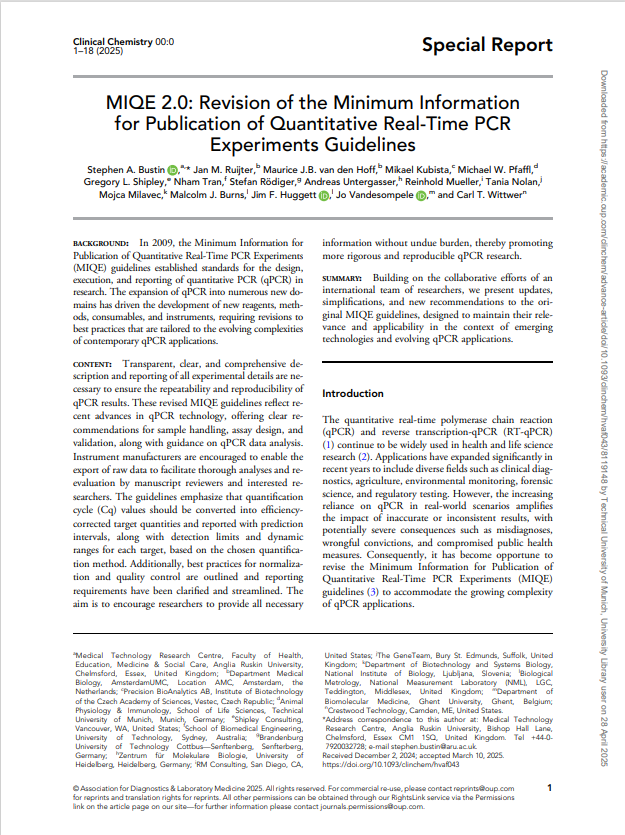
Why MIQE 2.0 Matters
The new guidelines place particular emphasis on proper sample handling and transparent documentation.
- Clear standards for reproducibility
- Incorporating the right controls
- Tips for publications and reviews.
With Promega reagents, you minimise sources of error and reliably meet MIQE requirements.
Polymerase Overview
| Application | GoTaq® G2 DNA Polymerase | GoTaq® G2 Flexi DNA Polymerase | GoTaq® G2 Hot Start Polymerase | Pfu DNA Polymerase |
|---|---|---|---|---|
| Genotyping | ✓ | ✓ | ✓ | ✓ |
| Multiplex PCR | ◯ | ◯ | ✓ | ◯ |
| Colony PCR | ✓ | ✓ | ✓ | ✓ |
| Fast PCR | ◯ | ◯ | ✓ | ◯ |
| High-Throughput | ◯ | ◯ | ✓ | ◯ |
| Cloning & Subcloning | ◯ | ◯ | ◯ | ✓ |
| Site-Directed Mutagenesis | ◯ | ◯ | ◯ | ✓ |
| Template Generation for Sequencing | ◯ | ◯ | ◯ | ✓ |
| Properties | GoTaq® G2 DNA Polymerase | GoTaq® G2 Flexi DNA Polymerase | GoTaq® G2 Hot Start Polymerase | Pfu DNA Polymerase |
|---|---|---|---|---|
| 5'–3' Exonuclease Activity | ✓ | ✓ | ✓ | ◯ |
| Proofreading Activity | ◯ | ◯ | ◯ | ✓ |
| Amplicon Size | <5 kb | <5 kb | <5 kb | <10 kb |
| Enzyme Type | Recombinant | Recombinant | Recombinant | Native |
| PCR Product Overhang | 3' A | 3' A | 3' A | Blunt Ends |
| Room Temperature Setup | ◯ | ◯ | ✓ | ◯ |
| Colorless Reaction Buffer | ✓ | ✓ | ✓ | ✓ |
| Colored Reaction & Loading Buffer | ✓ | ✓ | ✓ | ◯ |
| MgCl₂ Included in Reaction Buffer | ✓ | ◯ | ◯ | ◯ |
| MgCl₂ in Separate Tube (25 mM) | ◯ | ✓ | ✓ | contains MgSO₄ |
Master Mix Overview
| Application | GoTaq® G2 Master Mixes | GoTaq® G2 Hot Start Master Mixes | GoTaq® Long PCR Master Mix | ||
|---|---|---|---|---|---|
| Colorless | Green | Colorless | Green | ||
| Genotyping | ✓ | ✓ | ✓ | ✓ | ✓ |
| Long PCR | ◯ | ◯ | ◯ | ◯ | ✓ |
| Multiplex PCR | ◯ | ◯ | ✓ | ✓ | ✓ |
| Colony PCR | ✓ | ✓ | ✓ | ✓ | ✓ |
| Fast PCR | ◯ | ◯ | ✓ | ✓ | ✓ |
| High-Throughput | ◯ | ◯ | ✓ | ✓ | ✓ |
| Cloning & Subcloning | ◯ | ◯ | ◯ | ◯ | ✓ |
| Site-Directed Mutagenesis | ◯ | ◯ | ◯ | ◯ | ✓ |
| Template Generation for Sequencing | ◯ | ◯ | ◯ | ◯ | ✓ |
| Properties | GoTaq® G2 Master Mixes | GoTaq® G2 Hot Start Master Mixes | GoTaq® Long PCR Master Mix | ||
|---|---|---|---|---|---|
| Colorless | Green | Colorless | Green | ||
| 5'–3' Exonuclease Activity | ✓ | ✓ | ✓ | ✓ | ✓ |
| Proofreading Activity | ◯ | ◯ | ◯ | ◯ | ✓ |
| Amplicon Size | <5 kb | <5 kb | <5 kb | <5 kb | <40 kb |
| Enzyme Type | Recombinant | Recombinant | Recombinant | Recombinant | Recombinant |
| PCR Product Overhang | 3' A | 3' A | 3' A | 3' A | 3' A blunt |
| Room Temperature Setup | ◯ | ◯ | ✓ | ✓ | ✓ |
| Colorless Reaction Buffer | ✓ | ◯ | ✓ | ◯ | ✓ |
| Colored Reaction & Loading Buffer | ◯ | ✓ | ◯ | ✓ | ◯ |
| MgCl₂ Included in Reaction Buffer | ✓ | ✓ | ◯ | ◯ | ✓ |
| MgCl₂ in Separate Tube (25 mM) | ◯ | ◯ | ✓ | ✓ | ◯ |
The Wait is Over: qPCR Lumie is Here
From 1 October to 18 December 2026, order any qualifying PCR or qPCR product and claim a free qPCR Lumie for your desk or lab bench. Don't miss out—place your order now and elevate your PCR and qPCR expertise with your complimentary qPCR Lumie. Claim yours today >
Terms and conditions apply. See below for eligible products.
| Product Code | Product | Product Code | Product |
|---|---|---|---|
| A6001 | GoTaq® qPCR Master Mix, 5ml | A6002 | GoTaq® qPCR Master Mix, 25ml |
| A6010 | GoTaq® 2-Step RT-qPCR System, 5ml | A6020 | GoTaq® 1-Step RT-qPCR System, 5ml |
| A6101 | GoTaq® Probe qPCR Master Mix, 2ml | A6102 | GoTaq® Probe qPCR Master Mix, 10ml |
| A6110 | GoTaq® Probe 2-Step RT-qPCR System, 2ml | A6120 | GoTaq® Probe 1-Step RT-qPCR System, 2ml |
| A6121 | GoTaq® Probe 1-Step RT-qPCR System, 12.5ml | A6220 | GoTaq® Endure qPCR Master Mix, 200 rxn |
| A6221 | GoTaq® Endure qPCR Master Mix, 1000 rxn | A6222 | GoTaq® Endure RT-qPCR System, 200 rxn |
| A6223 | GoTaq® Endure RT-qPCR System, 1000 rxn | A6224 | GoTaq® Endure qPCR Direct Amp Bundle |
| A6225 | GoTaq® Endure RT-qPCR Direct Amp Bundle |