Unpacking ISHI 37
What Stayed With Me After
the Final Session
My experience of being this year’s UK ISHI Student Ambassador has been truly remarkable. The opportunity to attend and present my work at a conference where the world’s leading forensic science experts, legal professionals, and fellow students come together to share their work was a privilege I will carry with me. Choosing one highlight from the event is difficult, but interviewing Dr Tim Kalafut of Sam Houston State University stood out. We explored the importance of researching activity-level propositions to communicate how DNA has been deposited onto a surface, a question close to my own work interpreting low-level DNA from earprints. From presenting my first poster to the workshops and conversations in between, I have returned to the lab with fresh ideas for my research and a much wider community behind me.
I arrived at the conference nervous and excited, as it was my first international conference and the first time I would present my research on such a huge stage. I quickly found that fellow attendees were just as eager to meet me, and I soon realised I had no reason to be nervous. The workshops gave me the opportunity to look more deeply into topics that I had only read about and to ask experts in these fields questions directly. One of the best examples was Bayes to Bench, chaired by Dr Michael Coble, with presentations from Dr Jo-Anne Bright and Richard Wivell. Through talks, games, and other engaging activities, the workshop covered everything from the foundations of Bayes’ theorem and likelihood ratios to the challenges of interpreting complex DNA mixtures, including examples with five or six contributors. Because my own earprint samples have contained DNA from more than one person, this workshop helped me better understand how mixed profiles are interpreted and explained in court. By the end of the session, I connected with forensic and reporting scientists around me while learning from their experiences working in a lab and giving evidence.
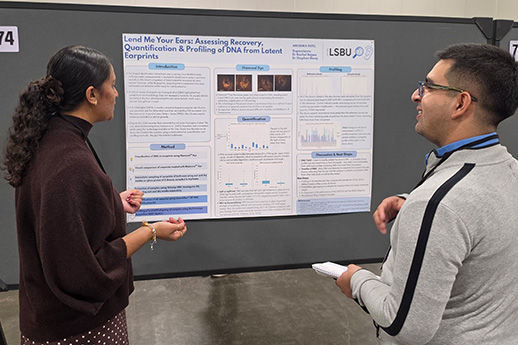
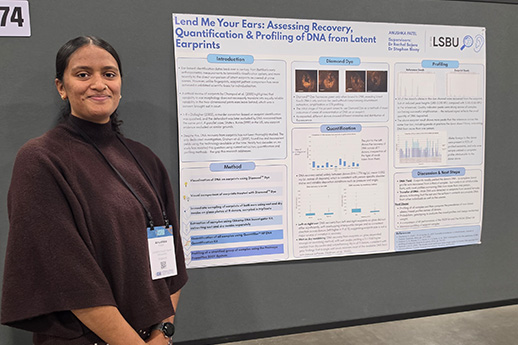
I presented my poster on Wednesday and was surprised to find interest from fellow students, forensic scientists and vendors alike. The feedback has been extremely helpful as I continue my project, and it was useful to see other posters using methods similar to my own plan. I am thankful for the rare opportunity to ask researchers questions directly and bring those ideas back to my work.
This year’s ISHI talks centred on analysing challenging evidence types and applying newer methods such as whole genome sequencing and forensic investigative genetic genealogy to bring cases to justice. I was inspired by experts' commitment to building robust, well-researched frameworks for using these methods in casework. One talk I was especially keen to hear was Edie Holmes’ talk on the SCAnDi project, which explores linking individual cells to their DNA profiles to resolve complex mixtures. Mixed DNA is a challenge for my own samples too, and it was fascinating to see how single-cell approaches could show not only whose DNA is present, but what kind of activity it reflects and where it might have come from.
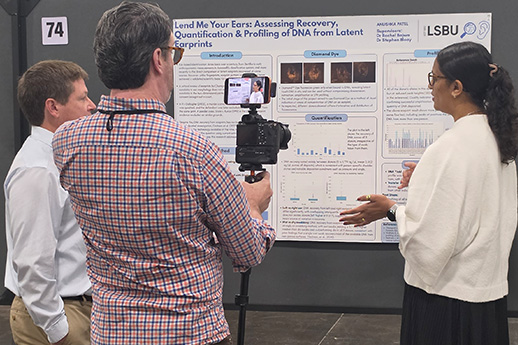
Alongside the talks, one particular highlight was interviewing Dr Tim Kalafut. We talked about his path from toxicology into forensic DNA, bringing STRmix into casework, and communicating likelihood ratios to a jury. What I valued most was the discussion of activity-level evaluation: as modern kits detect ever smaller amounts of DNA, how it got onto an item is a very important question, and a harder one to answer, which I face with trace DNA from earprints. Throughout, he kept the conversation light with his humour, which made it as enjoyable as it was informative.
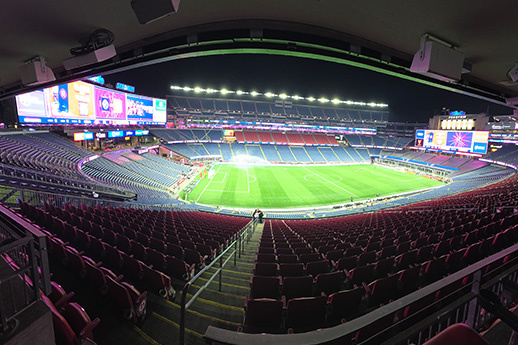
On the Wednesday evening, the conference dinner took place at Gillette Stadium, where we enjoyed dinner and watched the New England Revolution play the New York Red Bulls alongside fellow student ambassadors and other attendees. The atmosphere was relaxed and fun, with plenty of music, great food and dancing, and it gave us a chance to talk away from the poster hall and the lecture rooms.
I am immensely grateful to the Promega UK team for their support throughout my experience as this year’s student ambassador, and to my supervisors, Dr Rachel Bajwa and Dr Stephen Bleay, for their guidance.
What I will remember most is how much impact can come from the smallest piece of evidence when it is recovered carefully, interpreted honestly and communicated clearly. From mixture interpretation to single-cell analysis to the courtroom, many of the sessions pointed to one theme: careful science, and the people committed to it, turn evidence into justice. I return to the bench determined to bring that standard to my own work on earprints.