All Roads Lead to Forensic Genetics: My Journey to ISHI 37
How Getting More From Less DNA Has Shaped My Research and the Questions I Bring to ISHI 37
Forensic genetics is an ever-expanding, evolving field, and my path into it has been far from linear. My interest in forensic science took root through DNA analysis, specifically the Sierra Bouzigard case, where DNA phenotyping technology helped redirect a stalled investigation toward the right suspect. From there, my curiosity moved toward fingerprints, drawn in by the detail-oriented, pattern-based nature of fingermark enhancement and analysis. While pursuing my master's degree at King's College London, DNA analysis drew me back into forensic genetics. I began to see that my two interests were less separate than I had assumed: the same trace that holds a fingermark can also hold DNA. That intersection led me to my current research. As a first-year PhD student at London South Bank University, I am recovering DNA from earprints, a trace as visual as it is biological.
It is fitting, then, that I am supervised by two people whose backgrounds reflect this very intersection. My Director of Studies, Dr Rachel Bajwa, spent seven years with the Metropolitan Police before joining LSBU. My second supervisor, Dr Stephen Bleay, spent nearly 25 years in the UK scientific civil service, including as Senior Technical Specialist within the Home Office's Fingerprint Research Group, and is a principal author of the Home Office Fingermark Visualisation Manual. Together, they represent exactly the combination my earprint research depends on: real-world forensic grounding and deep expertise in the fingermark enhancement techniques I am now applying to a different kind of trace evidence.
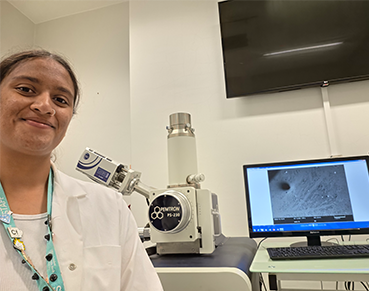
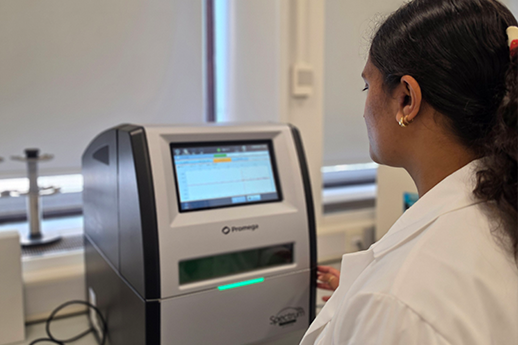
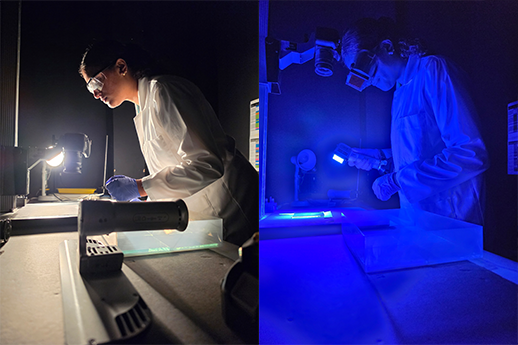
Under their guidance, I will present my first poster at ISHI 37, on recovering and analysing DNA from earprints. Earprints gained popularity in the early 2000s for their distinctive morphology, often compared to fingerprints, but interest declined as the ear's flexibility and the resulting subjectivity of interpretation made recovery and comparison difficult. DNA recovery was largely overlooked at the time, partly because techniques for analysing low copy number (LCN) DNA were only emerging. Today's DNA profiling technologies can analyse LCN DNA, but this sensitivity requires careful interpretation before any result reaches a courtroom. Important considerations also include DNA transfer, persistence, and recovery, as well as the prevalence of background DNA already present on a surface. My project sits in that gap, examining the biological and chemical intelligence earprints offer, striving to extract more from this trace evidence than a DNA profile alone, and working out what contextual information is needed to interpret a profile from an earprint.
Because my own research relies on recovering and interpreting DNA from such small quantities, I am particularly looking forward to participating in Dr Jack Ballantyne's workshop on single-cell analysis at ISHI. His research at the National Center for Forensic Science explores how much probative information can be drawn from very little genetic material, including RNA profiling to identify body fluids and tissues, attributing a cell type to its contributor, and analysing individual cells to deconvolute mixed DNA profiles. I am especially interested in the discussion around how single-cell methods could be validated and implemented in practice. Mixed, low-level DNA is exactly the challenge I face with earprints, which makes this discussion highly relevant to my own work.
While my path here has not been linear, every turn has led directly to the questions I am now trying to answer, and ISHI 37 is a chance to explore them alongside the wider forensic genetics community.