Measuring the Endogenous Expression
of Peroxisomal Proteins using Highly Sensitive Dual-Luciferase® Reporter Technology and
the GloMax® Discover
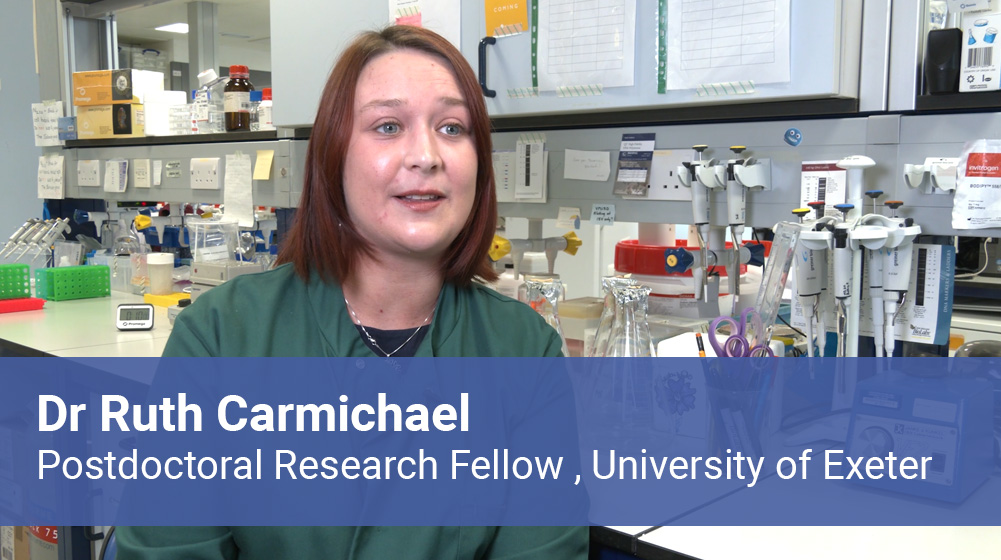
Dr Ruth Carmichael is a Postdoctoral Research Fellow in the lab of Professor Michael Schrader at the University of Exeter. The Schrader lab focuses on the signalling pathways that regulate the abundance and function of peroxisomes. Peroxisomes are small, membrane-enclosed organelles found in eukaryotic cells, that perform a range of metabolic activities essential for maintaining cellular homeostasis. A primary function is to provide a compartment for the oxidation of fatty acids, although peroxisomes are also involved in lipid biosynthesis and regulation of reactive oxygen species (ROS) levels in the cell. Their role is therefore critical for human health. Patients with inherited peroxisomal disorders have severe neurological and developmental symptoms that can be lethal. Peroxisome dysfunction is implicated in diseases such as cancer, neurodegeneration and ageing.
The aim of Dr Carmichael’s research is to better understand how peroxisomal proteins are regulated in human cells, as very little is currently known about this process. She is investigating how peroxisome size and number is controlled within the cell, how they respond to the environment and how they communicate with other organelles. These findings could then be exploited for the development of therapeutics for diseases in which peroxisome regulation is dysfunctional.
Dr Carmichael has used a NanoLuc® luciferase-based tagging strategy to measure the endogenous expression of particular peroxisomal proteins of interest. She has used CRISPR to introduce the NanoLuc sequence into precise locations in the genome to create NanoLuc fusion proteins, allowing monitoring of protein levels in conditions that are physiologically relevant. She has also introduced a Firefly luciferase gene under a constitutive promoter using recombination, as an internal control to account for nonspecific cellular changes. To detect both luciferases, Dr Carmichael uses the Nano-Glo® Dual-Luciferase® Reporter (DLR) assay system and measures the bioluminescent signals on the GloMax® Discover multimode plate reader.
In this video, Dr Carmichael describes how the small size and sensitivity of NanoLuc luciferase, and the simplicity of the Nano-Glo DLR assay, has enabled her to develop a quick and easy method for studying peroxisomal protein expression that produces highly reproducible results, and can also be scaled up for high-throughput screening. She explains how the GloMax Discover plate reader, demonstrated here by Senior Research Technician Tina Schrader from the group, further increases the speed and simplicity of her experiments, as the software is very intuitive and Promega assay protocols are already preloaded onto the instrument.
Read the Journal of Cell Science research paper >
Explore the range of GloMax® plate readers >
Follow the Schrader Lab on Twitter >
View and download the video transcipt >
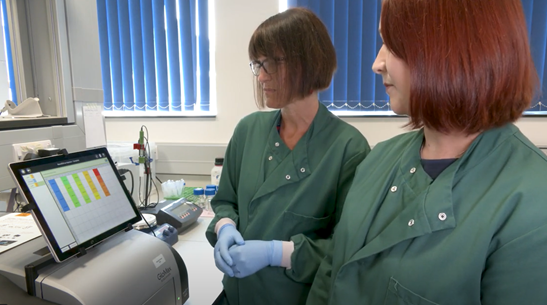
Dr Ruth Carmichael and Mrs Tina Schrader, Senior Research Technician, using the GloMax® Discover.