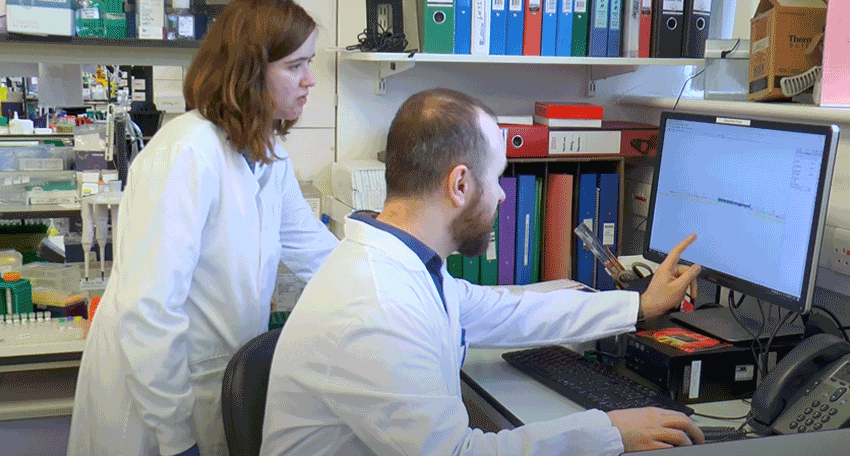
Dr Jacek Mokrosinski from the University of Cambridge describes the advantages of using NanoBiT for GPCR research

Postdoctoral Scientist Dr Jacek Mokrosinski, from Professor Sadaf Farooqi’s group at the University of Cambridge Metabolic Research Laboratories, is investigating novel G protein-coupled receptor (GPCR) variants that are found in patients with severe early onset obesity and studying their effects on receptor expression and intracellular signalling. The aim of his research is to identify molecular mechanisms that can be used to aid drug discovery and development.
As part of this research, Dr Mokrosinski has been using the NanoBiT® PPI Assay to monitor β-arrestin recruitment to Melanocortin 4 Receptor (MC4R), a GPCR whose disruption has been shown to cause obesity. NanoBiT is a bioluminescent structural complementation reporter system in which two subunits of NanoLuc® luciferase, optimised to have low affinity for each other, are fused to two proteins of interest. When the two proteins interact, the subunits are brought together to form an active enzyme and generate a bright luminescent signal.
In this video, Dr Mokrosinski describes how the small size of the two NanoBiT® subunits is incredibly beneficial for studying β-arrestin recruitment, as it ensures minimal interference with the normal protein function of GPCRs. In addition, the NanoBiT® Assay can be performed in live cells, allowing this interaction to be monitored in real time.
Read the Cell paper from Dr Mokrosinski’s lab >
Learn more about NanoLuc in GPCR research >