Measuring Lipid Accumulation in 3D Liver
Cell Cultures Using Triglyceride-Glo™ Assay
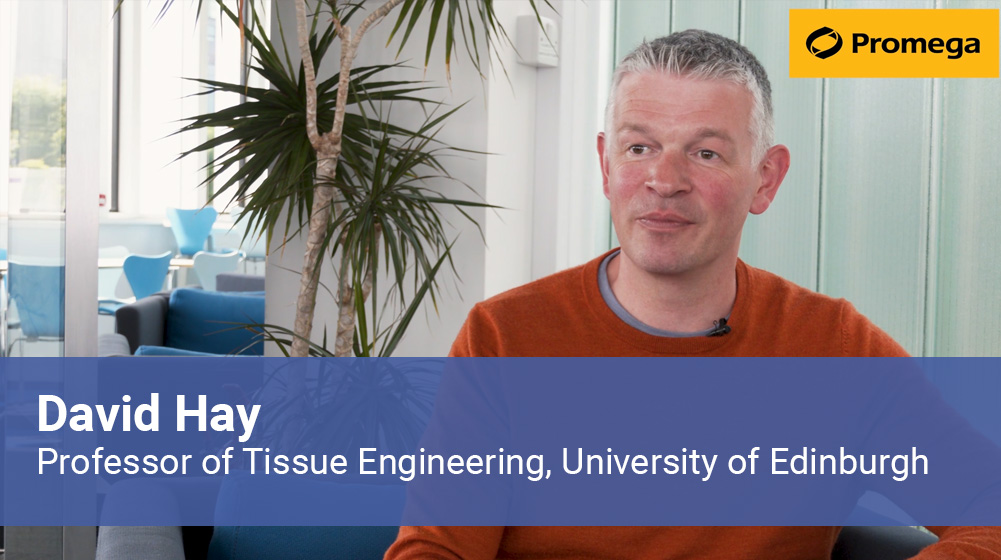
Professor David Hay is group leader of the Pluripotent Stem Cell Hepatocyte Development team, based in The Centre for Regenerative Medicine at the University of Edinburgh. Professor Hay’s lab use human embryonic stem cells and induced pluripotent stem cells to grow 3D liver tissues in the laboratory. This lab-grown liver tissue behaves in a similar way to liver found in the human body and can be used for drug development and for modelling human disease such as Non-alcoholic Fatty Liver Disease (NAFLD).
Alvile Kasarinaite is a PhD student in Professor Hay’s lab. She researches sex-dependent differences in NAFLD using the stem cell-derived liver tissue she generates using the lab’s methods. To assess the accumulation of triglycerides in cultured liver tissue, Alvile uses Triglyceride-Glo™ Assay, a modern, luminescent-based technique that is quick to use and generates quantifiable results.
In this video, Professor Hay and Alvile explain how they use a range of Promega’s cell health and metabolism assays, including Triglyceride-Glo™ Assay, to monitor the lab-grown liver tissues and to study the differences between healthy and steatotic liver tissue. The ultimate aim of this work is to generate a source of implantable liver tissue, which can be used as an alternative to liver transplants for patients whose own livers are failing.
Learn More about Triglyceride-Glo™ Assay
Discover the Full Range of Energy Metabolism Assays
Download the PDF of the case study here >
View and download the video transcript >