Harnessing Earth's Warmth: Ground Source Heat at Promega UK
August 2023
Ground (or air) source heat pumps are apparently the future but what are they and how do they benefit the environment? Rob Holmes, PhD, Promega UK’s Facilities Manager says “Heat pumps may well be the future, but they are also here now. They are often portrayed as a new technology, just coming of age, but the heat pump was first conceived in the 1850s, and nearly every home has one already – the fridge.”.
"Heat pumps may well be the future, but they are also the now."
- Rob Holmes, PhD, Facilities Manager, Promega UK
There are many ways to look at how a heat pump works, but a great one is that it’s a fridge, turned inside out. “A fridge doesn’t create cold – it relocates heat”. In the case of a fridge, it moves heat from the inside, to the outside (the radiator on the back of the unit). When heating a building we want to use the hot side of the system. “During winter, we are cooling the ground with our ground source heat pumps, using the same principles that your fridge uses - but the hot side is inside the building. In summer we can turn that around and cool the building and put the heat back into the ground”.
But why is this beneficial versus a traditional boiler? ”Firstly, heat pumps use electricity and so, if you obtain your electricity from a carbon neutral source, your heating can be carbon neutral, unlike a gas boiler”. But why not use a much cheaper and simpler electric immersion heater? “It’s a bit more complex – heat pumps relocate rather than generating it. A 100% efficient immersion heater would use 1 kW of electricity to generate 1 kW of heat. But a heat pump can relocate 3-4 kW of heat for every 1 kW of electricity used.”. So not only do heat pumps not burn fossil fuels, but they use three to four times less electricity than an immersion heater would.
Here at Promega UK we are proud to have installed two reversible ground source heat pumps into our UK facility, when it was constructed in 2019. “While over 50% of the UK's electricity is provided by zero carbon sources, we wanted to go further and faster - so Promega UK purchase a 100% non-carbon tariff, certified by OFGEM’s REGO scheme”. This means that Promega UK are carbon neutral for the heating and cooling of our UK facility, as well as for the temperature-controlled storage of our products in the UK”. Derek McCall, Promega UK Managing Director, says “We are excited to play our part in the UK’s decarbonisation and we are keen to engage with our customers to understand their experience of decarbonising their operations too”.
"We are excited to play our part in the UK's decarbonisation and really keen to talk with our customers to understand their experience of decarbonising their operations too".
- Derek McCall, Managing Director, Promega UK

“The Icy Depths”.
The central lawn area, dubbed “The Icy Depths”. Below this serene surface, boreholes plunge 130m into the ground, housing the veins of our ground source heat pump system.
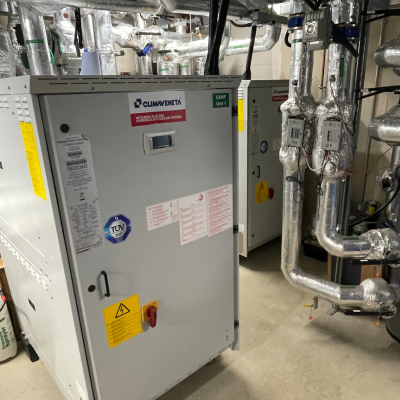
“Ugly Grey Boxes”.
Piping in the plant room, known as the “Ugly Grey Boxes”. These unassuming ground source heat pumps play a pivotal role in heating or cooling our building, depending on the season, marking a significant stride in Promega UK’s decarbonisation journey.
FAQs
What is the difference between and an air source heat pump and a ground source heat pump?
The heat pump is very similar, but the source of the heat is different. Ground source heating relocates the heat form cooling the ground, but air source heating relocates the heat from cooling the air. Deep ground temperature is more stable and at its coldest is never as cold as the air can be.
Are Ground source heat pumps better than air source heat pumps?
Ground source systems are typically more efficient but difficult to retrofit and require ground access and are therefore more suitable for new buildings with some accompanying land.
Are ground source heat pumps expensive to run?
The price comparison between running a GSHP and a gas boiler varies with the relative prices of gas and electricity (although they are linked) and the temperature of the soil. Typically, gas is three to four times cheaper per kwh and is more volatile in pricing, while GSHPs are three to four times more efficient per energy input in. There isn't much in it.
Is the water really hot enough to heat a building?
Yes! The water from our pumps is 40 to 50 degrees. This is perfect for underfloor heating and our fan assisted trench heaters. Neither are that common domestically and domestic systems are often air source heat pumps with a top up immersion heater.
Is it hot enough for a shower?
Technically, yes, but... A 45 degree shower would be too hot but we have a hot water tank to meet the domestic water needs (i.e. showers, sinks etc) and legionella regulations require stored domestic water to be at 60 degrees or above. We use a plate heat exchanger to prewarm the domestic water and then top up with an electric immersion heater.
Does the water from the ground go into your heating system?
No, the heat is transferred between the water in the borehole system (which is a closed loop and stays within pipes even when in the ground) and the building system water - through a heat exchanger in the ground source heat pump itself.
Glossary:
GSHP - Ground Source Heat Pump
ASHP - Air Source Heat Pump
Non-carbon energy - Renewables and Nuclear
REGO - Renewable Energy Guarantees of Origin